

Architects Didn't Lose Control of CA. They Defaulted It.
📰 Architects often lose control of construction administration (CA) by default, forcing senior staff into low‑value data entry. AI can automate the admin tasks helping firms reclaim ownership, boost efficiency, and protect liability.
When something goes wrong on site and the record of what actually happened lives in your email and a spreadsheet, whose story gets believed?
Summary
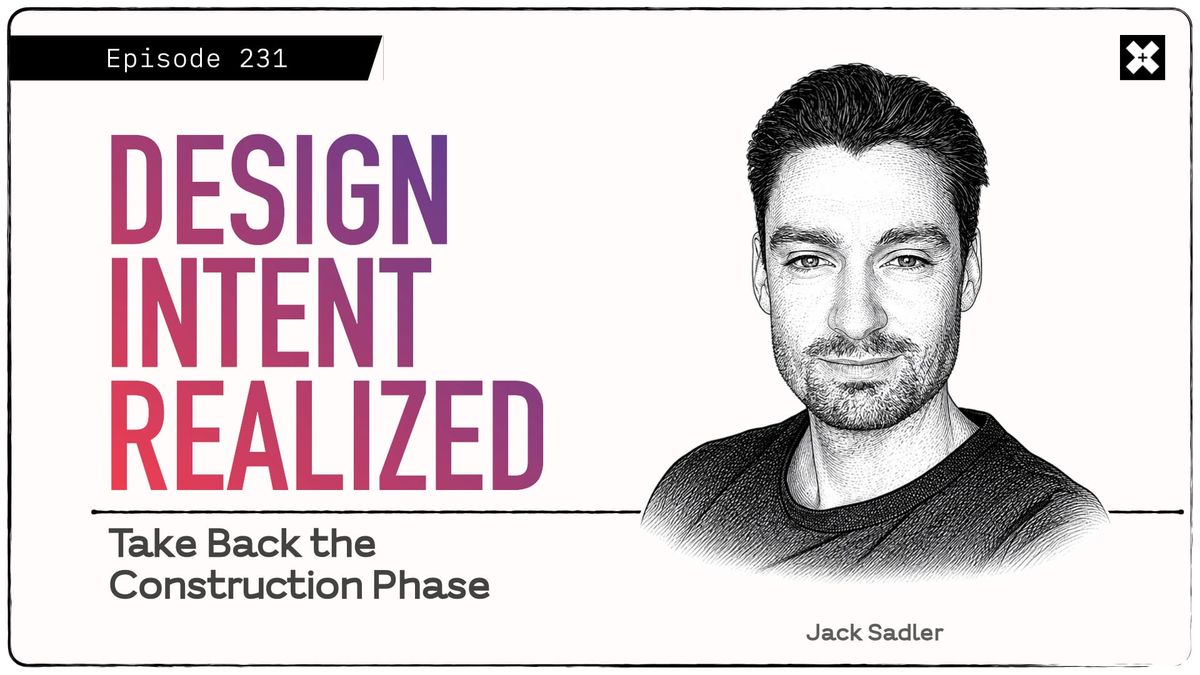
Construction administration is the phase where a project either gets built the way it was designed or it doesn't. That's the stakes Jack Sadler, co-founder and CEO of Part3, put on the table in our conversation in TRXL 231. Jack is the first to tell you he's not an architect. His background is vertical SaaS and custom software, and Part3 came out of watching his wife go from a contractor's fully-tooled environment to running an architecture firm's CA out of spreadsheets and email. He saw the gap up close and built for the side of the table that usually gets ignored.
We talked about why CA became a cost center instead of a profit center, why architects keep finding themselves working inside the contractor's tools and the contractor's version of events, and how AI can take the administrative grind off senior people without touching professional judgment. Jack's reframing of the issue: architects haven't lost control of CA because they wanted to give it up. They lost it by default, by letting decisions about tools and workflows get made without them.
This isn't another AI hype conversation. It's a grounded look at the seemingly least-loved phase of practice, the one where your most expensive people do your least valuable work (read: email and spreadsheets, not the actual construction process), and a real argument for why now is the moment to take it back.
What's Inside
- Accepting the defaults. Why architects keep ending up inside the contractor's software, and what it costs them when a project goes sideways.
- The cost center problem. CA generates revenue and still loses money, and the reason has nothing to do with how hard people work.
- Controlled transparency. Why Jack abandoned his original belief that everything should be visible to everyone, and what he replaced it with.
- Automate the admin, not the judgment. Where the line sits between what AI should handle in CA and what it should never touch.
- The conductor problem. What happens to the junior architect learning CA when the baseline gets handed to them, and whether that's a gain or a loss.
Click here for the link to the live stream (and recording) and get a calendar invite.
Episode Analysis
Whose Software, Whose Story
The contractor's side of CA has no shortage of tools. Procore, Autodesk, e-Builder, Trimble, Aconex, every size and shape. The architect's side has traditionally been spreadsheets and email. So when CA lands on the design team, they just move into the contractor's environment by default, and Jack's point is that the default carries hidden freight.
"We've accidentally let the contractor not only decide the software, but we've let them decide how the workflows are gonna run, what the team responsibilities are gonna be, what the rules and the data tells us about how the project went. Everything is told from one perspective."
That's fine when everything goes well. The trouble shows up when it doesn't, and your version of events lives somewhere undiscoverable.
"Letting the contractor control the story, the narrative, the data, the workflows, if something does go wrong, it makes it very difficult to tell your story, tell your side of events when yours lives in spreadsheets and email and is not discoverable and not easy to track."
The liability research backs this up. The common thread in most CA-related claims against architects isn't bad design. It's inadequate documentation, the inability to prove when a submittal was reviewed, who approved it, and how a discrepancy was handled.
Why the Most Expensive People Do the Least Valuable Work
Jack had two quotes from architects that frame the business problem better than any pitch deck could. One principal told him the whole goal in CA is to not lose all the money you made in design. And he described what a full day of CA actually looks like:
"They'll go from being an architect in the morning to a project manager to an accountant to a lawyer, to a psychiatrist managing the team, and then all the way back to an architect again in the same day."
Here's the mechanism that makes CA a cost center: Firms staff it with senior people because the phase genuinely needs professional judgment. Then those expensive people spend their hours chasing consultants, logging documents, and uploading files into someone else's system. The judgment is worth a lot. The data entry is not. The bill goes out at the same rate for both.
"If we can enable that one really senior person on a project to run three projects or four projects instead of the one, then it's no longer a cost center."
That's the whole argument compressed into a sentence. Not replace the person. Multiply them.
Controlled Transparency, and the Line AI Shouldn't Cross
One of the more honest moments was Jack admitting he got something wrong early. Part3 launched on the belief that raw transparency was best for the industry, that everything should be visible to everyone. Customers talked him out of it, one request at a time.
The reason is something every architect understands in their bones. Nobody wants to work in public while the thinking is still in flight. An architect doesn't want the contractor seeing an approval before the structural engineer has weighed in. So in fully transparent tools, they pull the work back out into email to do it privately, and the "automated" workflow turns into theater. Part3's answer is to let you work transparently with your consultants, then share with the contractor and client when you decide it's ready.
"During the project, it's controlled transparency."
The same instinct shapes how Jack talks about AI, and this is where the conversation earns its keep. AI in CA should categorize, name, route, scan submittals for missing data, and remind you where you left off. It should not make the call.
"AI is the best way to automate administration. It should not automate professional judgment, but that's the whole point. It should be automating the pieces."
He's also clear-eyed about the risk. Left unattended, AI pulls everyone toward the average.
"By nature, what AI will do is help you default to the average that exists out there. If you're a great writer, you should probably aspire to do a little bit better. The same thing will happen in architecture."
The fix isn't to avoid the tools. It's to use them to reach the baseline in minutes so you have the time to go beyond it. That reframes the architect's role from doing to conducting, deploying agents like interns that gather and flag while you keep the judgment. And it lands on the real enemy of good CA: context switching. Jack uses a 10 percent tax per task, the difference between being fully focused on one thing and 45 percent focused on two. An assistant that can tell you "here's where we left off, here's what we got stuck on" gives those points back.
"I think of CA as the phase where design intent is realized or negotiated away. And too often, the negotiation's happening and you're not at the table."
— Jack Sadler, co-founder and CEO of Part3
Connect the Dots
This conversation builds on ideas explored in previous episodes:
- TRXL 219: 'Keeping Architects in the Driver's Seat' — George Guida and I covered the same core tension Jack names, architects holding onto authorship and control instead of ceding it to downstream tools and decisions, from the design technology angle.
- TRXL 222: 'You're Automating the Wrong Thing' — Mirco Bianchini's argument pairs directly with Jack's line that AI should automate administration and never professional judgment, a useful gut-check before you point automation at the wrong part of your practice.
Conclusion
The thread running through this whole conversation is ownership. Not more responsibility, not more hours, just taking deliberate control of the phase you're already on the hook for: the flow of information, the source of truth for every decision, the workflow of your consultant team. CA doesn't have to be the place where firms bleed margin and lose their version of events. With the administrative weight automated and the judgment kept human, it can become the thing you point to in an interview, the proof that you don't just design well, you execute when something goes wrong.
What I Didn't Say on the Show
The reason CA gets dumped on the junior person isn't really about cost, it's about how little we've valued the phase. We treat it as dues to be paid rather than a place where real expertise gets built. Jack's automation argument “threatens” that whole tradition, and I'm not sure the industry has thought through what it means. If a 24-year-old gets the code baseline and the submittal gaps handed to them in minutes, they skip the years of figuring it out the hard way. That's a real gain in speed and a real risk to how judgment gets formed. I don't think Jack has the full answer, and neither do I. But it's the question underneath the whole CA conversation, and we're going to have to teach our way through it, not automate our way around it.
My Question for You
If you had to defend your firm's last difficult project in front of a lawyer tomorrow, could you produce a clean, time-stamped record of every decision and why it was made, or would you be reconstructing it from your team’s inboxes and from mis-filed files strewn across who knows how many folders on various file sharing platforms?
Practical Recommendation
Before you evaluate a single tool, run Jack's diagnostic on your own firm. Pick one active project in CA and answer three questions honestly: Do you control where information lives, or does it live in the contractor's system? Can you tell the story of when each submittal and RFI was reviewed and why? Do you dictate how your sub-consultants work with you, or are you adapting to everyone else's process? Wherever the answer is no, that's a gap you've defaulted on, not one you chose. Write those gaps down. That short list, not a software demo, is the actual starting point for taking CA back, and it tells you exactly what any tool you eventually pick has to solve.
Do these ideas spark your interest or make you want to dive deeper? Click the button below to listen to the full episode and read the show notes to get all the insights and details.
Comments ()